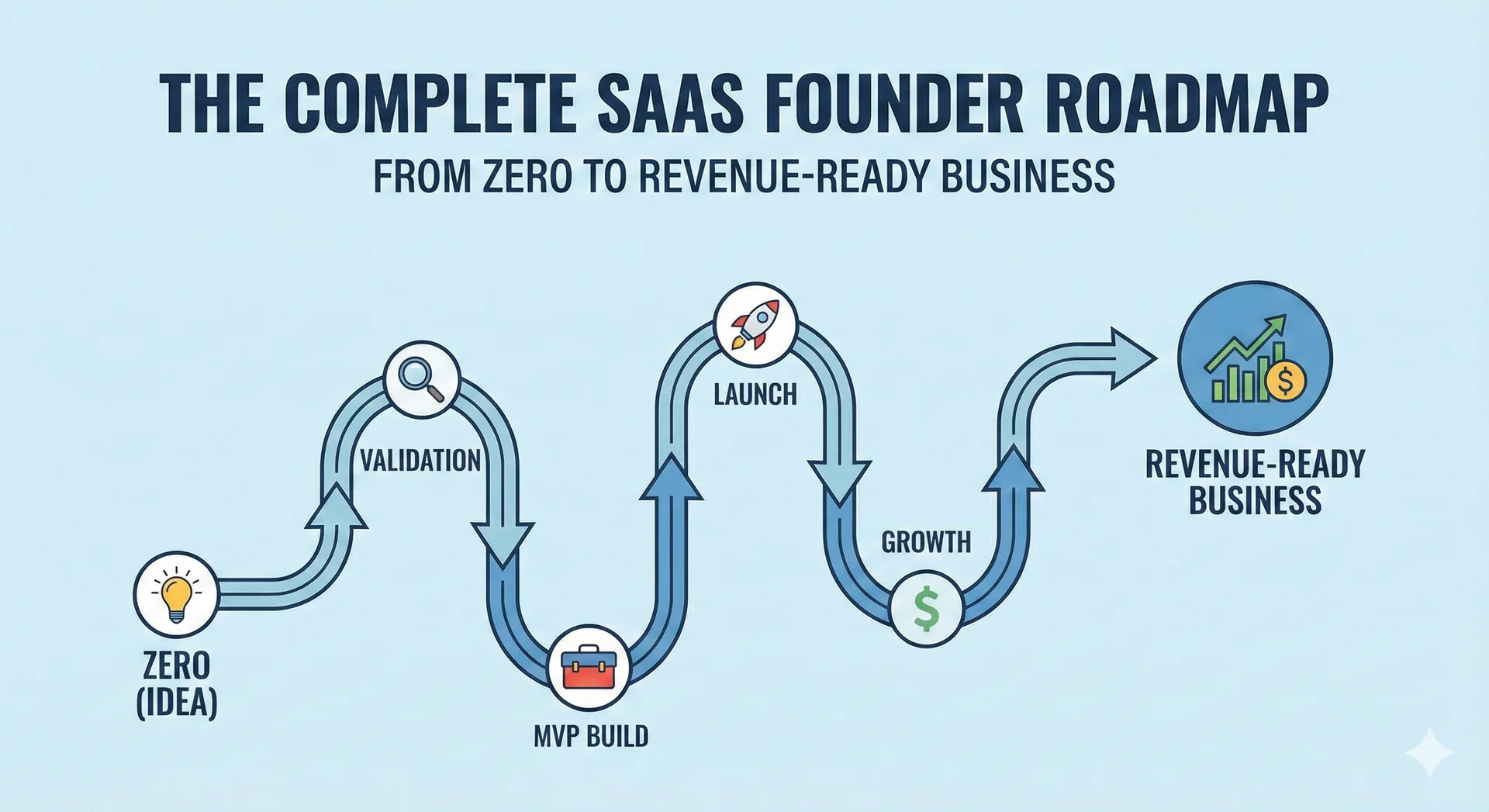
The Complete SaaS Founder Roadmap: From Zero to Revenue-Ready Business
Building a SaaS business can feel like navigating a maze blindfolded. You know there's a path to success, but every decision feels like a potential dead end.
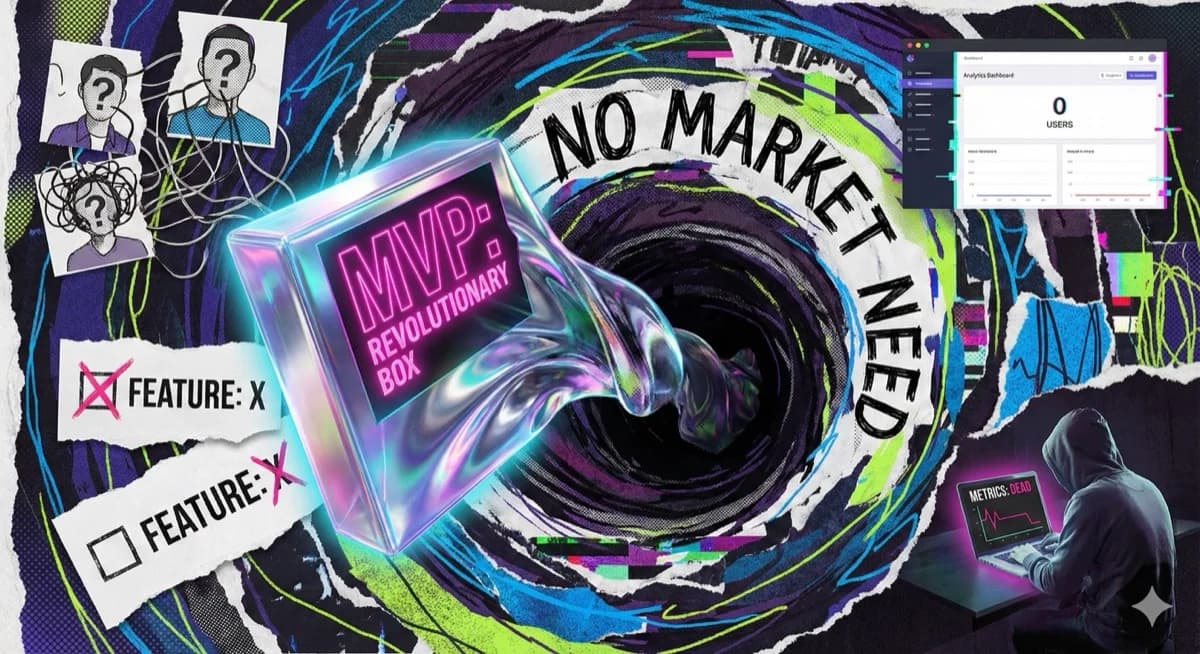
Here's the thing: 90% of SaaS startups fail during the MVP phase. Not because founders lack talent or vision—but because they follow the wrong roadmap or no roadmap at all.
This guide breaks down the entire journey into clear phases, with battle-tested strategies, detailed SOPs, and lessons from real failures so you can skip the pain and get to revenue faster.
Phase 1: Validation & Foundation (Weeks 1-4)
Discover Your Problem-Solution Fit
The most successful SaaS founders don't start with a product idea. They start with a problem worth solving. Ask yourself:
- What problems do I see repeatedly in my industry or network?
- What manual processes are people still stuck with?
- What existing solutions are people complaining about?
- Where are businesses losing money due to inefficiency?
Consider both the severity of the problem (how painful is it?) and the frequency (how often do people encounter it?). Your best opportunity lies where these intersect with your ability to solve it.
My Mistake: I built my first SaaS based on a problem I thought people had. Spent 4 months coding. Launched to crickets. When I finally talked to potential customers, they said, "Yeah, that's annoying, but we've got workarounds." I'd solved a minor inconvenience, not a burning problem. Now I validate before writing a single line of code.
Validate Before You Build
Before investing time and money, validate that your idea has legs:
Step 1: Customer Conversations (20+ minimum)
Talk to potential customers. Not friends or family—actual people in your target market. Focus on understanding their problems, not pitching your solution.
The questions that matter:
- "Walk me through the last time you dealt with [problem]"
- "What solutions have you tried? What didn't work?"
- "If this problem disappeared tomorrow, what would that be worth to you?"
- "How are you solving this today?"
Step 2: Quantify the Pain
A real problem has measurable cost:
- Hours wasted per week/month
- Revenue lost or missed
- Money spent on inferior solutions
- Team frustration and turnover
If potential customers can't quantify the pain, the problem isn't painful enough.
Step 3: Build a Pre-Launch List
Create a simple landing page describing the problem you're solving (not the solution yet). Collect emails. If you can't get 100 signups, that's a signal.
Use Carrd, Notion, or a simple one-page site. Include:
- Clear problem statement
- Who it's for
- Email signup for early access
- Optional: Brief survey to qualify leads
My Mistake: I skipped customer conversations because I "already knew the market." Built for 3 months in isolation. Launched. Got feedback that would have changed everything—feedback I could have gotten in week one. Twenty conversations would have saved me four months of wasted work.
Define Your Ideal Customer Profile (ICP)
Don't build for "everyone." Build for someone specific.
A strong ICP includes:
- Company size: Startups? SMBs? Enterprise?
- Industry: B2B SaaS? E-commerce? Healthcare?
- Role: Who's the buyer? Who's the user?
- Pain intensity: How desperate are they for a solution?
- Budget: Can they afford your solution?
Example ICP: "Marketing managers at B2B SaaS companies with 20-100 employees who are struggling with lead attribution and have budget authority up to $500/month."
Start narrow. You can expand later. Starting broad means competing with everyone for no one.
Set Your Business Foundations
Get the basics in place before you're drowning in customers:
- Business structure: Start simple (sole proprietorship or LLC)
- Separate finances: Open a dedicated bank account
- Billing infrastructure: Stripe for subscriptions (you'll need this in your MVP)
- Basic legal: Terms of Service, Privacy Policy templates
- Domain: Secure your brand name early
Phase 2: Building Your MVP (Weeks 5-8)
The MVP Mindset
An MVP is not a half-baked product. It's a fully functional solution to one core problem.
What MVP means:
- Minimum: Only the features essential to deliver core value
- Viable: Good enough that people will pay for it
- Product: A real solution, not a prototype or mockup
What MVP does NOT mean:
- Every feature you'll eventually want
- Perfect design
- Scalable architecture for millions of users
- All the nice-to-haves
The question to ask: "What's the minimum a user needs to reach their first 'aha' moment?"
Choose Your Build Path
You have three options:
| Approach | Timeline | Cost | Best For |
|---|---|---|---|
| Build yourself | 3-6 months | Your time | Technical founders with bandwidth |
| Hire freelancers | 2-4 months | $10K-$30K | Founders who can manage projects |
| MVP agency | 2-3 weeks | $3K-$8K | Founders who want speed and predictability |
My Mistake: I tried to build my first MVP myself while running my day job. Six months later, I had an 80% finished product, zero launches, and complete burnout. The opportunity cost of those six months—customers I could have acquired, feedback I could have gathered—was enormous. For my second startup, I used an agency and launched in 3 weeks. Game changer.
MVP Feature Prioritization
Use the MoSCoW method:
- Must-Have: Core functionality. Without these, the product doesn't work.
- Should-Have: Important but not critical for first launch.
- Could-Have: Nice to have. Build these after validation.
- Won't-Have: Future features. Park them for later.
For most B2B SaaS MVPs, you need:
- Core feature (1-4 main capabilities that solve the problem)
- User authentication (signup, login, password reset)
- Payment integration (Stripe for subscriptions/one-time)
- Basic dashboard (users need to see their data)
- Feedback mechanism (how will users tell you what's broken?)
That's it. Everything else is a distraction until you've validated with paying customers.
The MVP Development SOP
Week 1: Discovery & Scoping
- Finalize feature list (must-haves only)
- Define user flows and core journeys
- Choose tech stack (Next.js is our recommendation—here's why)
- Set up project management (Notion, Linear, or Trello)
Week 2: Design & Core Build
- Wireframe key screens
- Build authentication system
- Develop core feature functionality
- Set up database structure
Week 3: Integration & Polish
- Integrate payment processing (Stripe)
- Connect all features
- Basic UI polish
- Internal testing
Week 4: Launch Prep
- Deploy to production
- Set up monitoring and error tracking
- Create onboarding flow
- Prepare launch communications
What Your MVP Must Include
Based on hundreds of MVP launches, here's what separates ones that convert from ones that flop:
1. Instant Value Demonstration
Users should understand your value within 60 seconds. Use:
- Pre-filled sample data
- Interactive onboarding tour
- Clear first action (not a blank slate)
2. Monetization from Day One
Build Stripe integration into your MVP. You need to validate willingness to pay, not just willingness to sign up.
3. Feedback Loop
Add a simple feedback widget. You need to hear from users when things break or confuse them.
4. Professional UI
Your MVP doesn't need custom design, but it needs to look professional. Use established UI kits and component libraries.
Phase 3: Getting Your First 10 Customers (Months 2-3)
The Warm Outreach Strategy
Your first customers will likely come from people who already know you. This isn't a crutch—it's smart business.
Make a list of 50-100 people in your network: former colleagues, LinkedIn connections, industry contacts, founders you've helped. Let them know what you've built and who it's for.
The Exact Message Template That Works:
Hey [Name],

Quick update: I just launched [Product Name], a tool that helps [target customer] with [specific problem].

Based on [something you know about them/their company], I thought you might find it useful—or know someone who would.

If you're open to it, I'd love to give you a free trial and get your feedback. Would help me a ton in these early days.

Here's a quick look: [product link]

Either way, would love to catch up soon!

[Your name]
Don't ask everyone to buy. Ask for introductions, feedback, and referrals. This removes pressure and often leads to unexpected opportunities.
My Mistake: I sent vague messages like "I built something cool, check it out." Zero responses. When I got specific about who it's for and what problem it solves, I got 15 trial signups in one week.
Multi-Channel Lead Generation System
Waiting for customers to find you is a recipe for failure. Here's the system that generates consistent pipeline:
Channel 1: Daily Outreach (60 minutes/day)
Identify 10 potential customers daily. Send personalized messages on LinkedIn, email, or Twitter.
Daily Outreach SOP:
- 20 minutes researching: Find 10 companies/people who match your ICP
- 30 minutes writing: Craft personalized messages (mention specific details about their business)
- 10 minutes following up: Reply to responses, follow up on messages sent 3-7 days ago
The Outreach Formula:
Hi [Name],

I noticed [specific observation about their business/recent post/challenge].

I help [target audience] with [specific problem] by [your approach]. Recently worked with [similar company] to achieve [specific result].

Would love to explore if there's a fit to help [their company] with [relevant challenge].

Open to a quick 15-minute call this week?

Best,
[Your name]
Channel 2: Content Marketing (3-4 posts/week)
Share valuable insights on LinkedIn or Twitter. Focus on:
- Lessons from building your product
- Common mistakes your target audience makes
- Quick tips and frameworks
- Behind-the-scenes of your journey
Post consistently. Engage with comments. This builds visibility with your target market.
Channel 3: Community Engagement (1 hour/day)
Find where your ICP hangs out:
- Industry Slack communities
- Reddit subreddits
- Discord servers
- LinkedIn groups
Provide genuine value. Answer questions. Share insights. Don't pitch—build reputation first.
My Mistake: I only did outreach when I was desperate for customers. They could smell it. Conversion rates tanked. Consistent outreach—even when busy—keeps your pipeline full and removes desperation energy.
From Trial to Paid: The Conversion Playbook
Getting signups is one thing. Converting to paid is everything.
Step 1: Qualify During Signup
Ask 2-3 questions during onboarding:
- What's your biggest challenge with [problem area]?
- How are you solving this today?
- What's your timeline for implementing a solution?
This helps you prioritize high-intent leads and personalize follow-up.
Step 2: Fast Time-to-Value
Users should experience your core value within the first session. If it takes multiple logins to "get it," you'll lose them.
- Provide sample data or templates
- Offer guided setup for first-time users
- Send a personal welcome email with next steps
Step 3: High-Touch for Early Customers
Your first 10-20 customers deserve white-glove treatment:
- Personal onboarding calls
- Same-day response to questions
- Weekly check-ins during trial
This seems unscalable. It is. That's the point. You're learning, not optimizing.
Step 4: The Trial-to-Paid Conversation
Don't just let trials expire. Reach out proactively:
Hey [Name],

Noticed you've been exploring [specific feature]. How's it working for your workflow?

Your trial ends in [X] days. I'd love to hop on a quick call to:
- Answer any questions
- Help you get more value from [feature]
- Discuss whether the paid plan makes sense for you

Here's my calendar: [link]

If it's not a fit right now, totally understand. Would love your honest feedback either way.

[Your name]
Pricing Your SaaS
Most founders underprice. Here's how to think about pricing:
Value-Based Pricing Framework:
- What's the cost of the problem you're solving? (time, money, frustration)
- What's 10% of that value?
- That's your starting price floor
Example:
- Your tool saves 10 hours/month for a $100K/year employee
- That's ~$500/month in time saved
- 10% = $50/month minimum price
Pricing Display Best Practice:
Offer 3 tiers:
- Starter: Entry point, limited features
- Growth: Most popular, full features (anchor this one)
- Pro/Enterprise: Premium, advanced features
Customers usually pick the middle option. Make sure it's profitable for you.
My Mistake: I launched at $9/month because I was scared no one would pay. I attracted price-sensitive customers who churned fast and demanded the most support. When I raised prices to $49/month, I got better customers who valued the product and stuck around.
Phase 4: Scaling to $10K MRR (Months 4-8)
Complete Customer Onboarding SOP
A smooth onboarding sets the tone for the entire relationship. Here's the step-by-step process:
Step 1: Initial Response (Within 2 hours)
When someone signs up, respond fast:
Hey [Name],

Welcome to [Product]! Excited to have you.

To make sure you get the most value, I'd love to schedule a quick 15-minute onboarding call.

Here's my calendar: [Calendly link]

In the meantime, here are your quick-start resources:
- [Getting started guide]
- [Video walkthrough]
- [Common use cases]

Questions? Just reply to this email.

[Your name]
Step 2: Onboarding Call (15-20 minutes)
Structure:
- Minutes 0-3: Understand their specific use case
- Minutes 3-12: Walk them through setup for their needs
- Minutes 12-15: Answer questions, set expectations
- Minutes 15-20: Next steps and success metrics
Step 3: Day 3 Check-In
Hey [Name],

Quick check-in: How's your first few days with [Product] going?

Any questions or roadblocks I can help with?

If you haven't yet, here's the one thing I'd recommend doing next: [specific action that drives value]

[Your name]
Step 4: Day 7 Value Review
Hey [Name],

You've been using [Product] for a week now. Here's what you've accomplished:
- [Metric or milestone they've hit]
- [Feature they've used]

What's working well? What could be better?

Your trial converts to paid on [date]. Ready to continue? [upgrade link]

Questions? Let's chat: [calendar link]

[Your name]
My Mistake: I used to skip onboarding calls—thought they wouldn't scale. Lost 60% of trials. When I added personal onboarding for every user, conversion doubled. Eventually you'll automate this, but in early stages, high-touch wins.
Setting Up Recurring Revenue: Retainers & Annual Plans
Recurring revenue transforms your business from unpredictable to sustainable. Here's how to maximize it:
Annual Plans (Target: 30-40% of customers)
Offer a discount for annual commitment:
- Monthly: $49/month
- Annual: $39/month (billed yearly = $468)
The Annual Plan Pitch:
Hey [Name],

You've been crushing it with [Product] for [X] months. Your metrics:
- [Positive stat]
- [Value delivered]

Quick offer: Switch to annual and save 20% ($120/year).

Benefits:
- Lock in current pricing before we raise rates
- Priority support
- [Bonus feature or service]

Want me to switch you over? Just reply "yes" and I'll handle everything.

[Your name]
Expansion Revenue (Target: 20%+ of MRR)
Your best customers want to pay you more. Give them reasons:
- Add user-based pricing tiers
- Offer premium features
- Create add-on services
- Provide usage-based upsells
Customer Success SOP: Keeping Customers Happy
Churn kills SaaS businesses. Here's the system that maintains 95%+ retention:
Weekly Customer Health Check
Monitor these signals:
- Login frequency (dropping = churn risk)
- Feature adoption (using core features?)
- Support tickets (frustrated or engaged?)
- Payment issues (failed charges)
Proactive Outreach for At-Risk Customers:
Hey [Name],

Noticed you haven't logged into [Product] recently. Everything okay?

I'd hate for you to miss out on [recent feature/improvement]. Would a quick refresher call help?

If things have changed and [Product] isn't a fit right now, I totally understand. Would love to hear what's happening so I can learn.

[Your name]
Quarterly Business Reviews (for higher-tier customers)
Structure:
- Review metrics and ROI achieved
- Discuss challenges and roadblocks
- Preview upcoming features
- Identify expansion opportunities
My Mistake: I focused obsessively on new customer acquisition while ignoring existing customers. One month I celebrated 15 new customers—while 12 quietly churned. Net growth: 3 customers. Now I spend equal time on retention as acquisition.
The Follow-Up Tracker System
Most revenue is lost due to poor follow-up. Create a simple system:
| Customer | Status | Last Contact | Next Touch | Health Score | Notes |
|---|---|---|---|---|---|
| Acme Corp | Active | 11/15 | 12/15 | Good | Interested in annual |
| Beta Inc | At-risk | 11/01 | 11/25 | Low | Login dropped, email sent |
Set calendar reminders weekly. Consistent follow-up—without being pushy—is the highest ROI activity you can do.
Phase 5: Building a Sustainable Business (Year 1+)
Refine Based on Data
By now you have real customer data. Use it:
Analyze Your Winners:
- Which customer segments have lowest churn?
- Which acquisition channels have highest LTV?
- Which features correlate with retention?
Double down on what works. Cut what doesn't.
Metrics That Matter:
| Metric | Target | Red Flag |
|---|---|---|
| Monthly churn | <5% | >10% |
| CAC payback | <6 months | >12 months |
| Trial conversion | >25% | <15% |
| Day-1 retention | >60% | <40% |
| NPS | >40 | <20 |
When to Raise Prices
After 50+ customers and proven value, it's time:
Signs You're Underpriced:
- Close rate above 80%
- Customers say "this is a steal"
- Competitors charge 3x more
- You're drowning in support requests
How to Raise Prices:
- Grandfather existing customers (or give 90 days notice)
- Test higher prices on new customers first
- Add value when you increase price
- Be confident—don't apologize
My Mistake: I was terrified to raise prices. Kept my original $19/month for 18 months while delivering 10x the value. Finally raised to $79/month. Lost zero customers. Added $30K in ARR immediately. Price is a signal of value.
Build Your Growth Engine
Choose your primary growth channel based on your business:
| Channel | Best For | Time to Results |
|---|---|---|
| SEO/Content | High-intent searches | 6-12 months |
| Paid ads | Proven conversion funnel | Immediate |
| Partnerships | Complementary audiences | 3-6 months |
| Product-led | Self-serve product | 3-6 months |
| Outbound | Enterprise sales | 1-3 months |
Don't try to do all five. Master one before adding another.
Build Repeatable Processes
Document everything:
- Customer acquisition process
- Onboarding workflow
- Support response templates
- Monthly review cadence
- Feature prioritization framework
Your business should run consistently whether you're focused or distracted. Systems create sustainability.
The Biggest Mistakes (So You Can Skip Them)
Mistake #1: Building Before Validating
What happened: Built for 4 months based on my own assumptions. Launched to silence. The problem I solved wasn't painful enough.
The fix: 20 customer conversations before writing code. Build a waitlist first. Validate willingness to pay before building.
Mistake #2: Feature Creep Before Product-Market Fit
What happened: Kept adding features when early users asked for them. Product became complex and unfocused. Lost sight of core value.
The fix: Say no to 90% of feature requests until you have clear product-market fit (40%+ would be "very disappointed" without your product). Focus on one thing done exceptionally well.
Mistake #3: Ignoring Distribution
What happened: Built a great product. Assumed people would find it. They didn't. Spent months with zero customers.
The fix: Start marketing before you finish building. Build your audience while building your product. Distribution is as important as the product itself.
Mistake #4: Underpricing
What happened: Charged $9/month to "remove friction." Attracted price-sensitive customers who churned fast, complained most, and left bad reviews.
The fix: Price based on value delivered, not competitor prices or your comfort level. The right customers pay for value.
Mistake #5: No Systems or Processes
What happened: Every task felt like starting from scratch. Forgot to follow up with leads. Customer experience was inconsistent.
The fix: Create templates, checklists, and SOPs for everything. A 15-minute setup process should take 15 minutes, not 2 hours of reinvention.
Mistake #6: Founder Burnout
What happened: Worked 70+ hours weekly. Said yes to every customer request. Had no boundaries. Nearly quit.
The fix: Set working hours. Automate what you can. Hire help before you're drowning. A burned-out founder can't help anyone.
Mistake #7: Not Asking for Testimonials and Referrals
What happened: Had happy customers but no social proof. Made sales harder than necessary.
The fix: Every successful outcome ends with a testimonial request. Happy customers want to help—you just have to ask.
Mistake #8: Trying to Do Everything Alone
What happened: Spent 20 hours/week on tasks I wasn't good at. Opportunity cost was enormous.
The fix: Hire help early. A $15/hour VA can handle admin. A $3,999 MVP build can save months of your time. Focus on what only you can do.
Your Path Forward
Here's the pattern we see in SaaS startups that actually work:
- They validate before building. Pre-launch lists, customer conversations, quantified pain.
- They launch fast. Weeks, not months. Get to market before perfection.
- They focus on one ICP. At least initially. Narrow beats broad.
- They iterate based on data. Weekly improvements based on user feedback.
- They measure what matters. Activation, retention, churn, LTV.
- They build distribution alongside product. Marketing happens during building, not after.
The SaaS businesses that win aren't the ones with the most features. They're the ones that solve one problem exceptionally well for a clearly defined group of people—then expand from a position of strength.
Ready to Launch Your SaaS MVP?
At RocketMVP, we help founders skip the painful build phase and get to market in weeks, not months. Fixed pricing. Proven process. No surprises.
Stop planning, start launching. Book a discovery call and let's discuss your MVP.
What phase are you in right now? Reach out and let's talk about what's holding you back.